


Get inspired
In the news
What Class A means

What Class A means

Everybuilding material can be tested to see how it behaves in a fire. The resultsput it into a class from A (best) to F (worst). Class A is the top grade. A

Class A material:

  • won’t catch fire or keep a fire going
  • won’t give off much smoke
  • won’t drip burning bits that could start a fire lower down

Class A has two levels:

  • A1 doesn’t burn at all. Stone, concrete, porcelain, steel and     aluminium are all A1, often without needing a test, because they simply     can’t burn.
  • A2 barely burns. It might give off a tiny amount of smoke, but     nothing that helps a fire spread. Powder-coated aluminium is a typical     example, because the thin coating stops it being a full A1.

Both A1 and A2 count as Class A for theregulations.

When a material is tested as a floorsurface, you’ll see “fl” added, as in A1fl or A2fl-s1. It means the same thing.

Why timber and composite don’t qualify:
Timber is wood, so it burns. Composite decking iswood fibres mixed with plastic, so it burns too and the plastic can melt and drip.Fire-retardant treatments slow the burning down, but they typically only get aboard to Class B. That still counts as combustible, so it isn’t good enoughwhere Class A is required.

Why the rules exist
In 2017, the Grenfell Tower fire in London killed 72people. The fire spread up the outside of the building because of combustiblecladding that had been added during a refurbishment. Afterwards, the governmentdecided flammable materials on the outside of tall residential buildings weretoo dangerous.

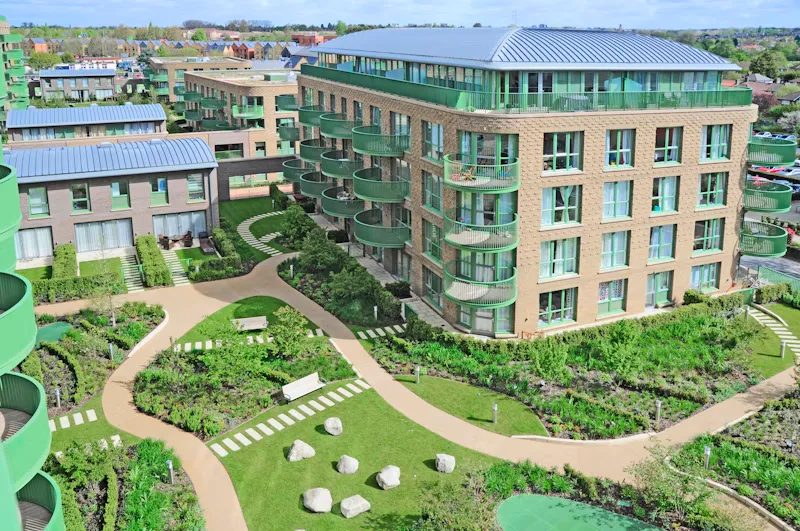
Balconies were included because they’re onthe outside of the building, so a fire on one can spread to the balconiesabove. They can also be where people go to escape or wait for rescue.

Law versus guidance
There are two kinds of rule, and the difference matters:

  • The Building Regulations are the law. You must follow them.
  • Approved Document B is the government’s official guidance on     how to meet the fire safety parts of the law. You’re expected to follow     it. If you want to do something different, you have to prove it’s just as     safe, and in practice building control will want strong evidence.

When Class A is needed (in England)

  1. Buildings 18m or taller (roughly six storeys or more) with     people living or sleeping in them. These are called “relevant buildings”:     flats, student halls, care homes, hospitals, hotels and boarding schools.     Since 2018, Class A on balconies has been the law here.
  2. Residential buildings over 11m (roughly four storeys or more).     Since December 2022, Approved Document B says balconies on these should be     Class A too. 
  3. Buildings under 11m. Class A isn’t required, but a British     Standard for balconies (BS 8579) recommends it wherever balconies are     stacked above each other or overlap. If the balcony below catches fire,     burning debris can fall or flames can reach upwards.
  4. What might change next. In 2026, the Building Safety Regulator     ran a consultation, which means it asked the industry for views on     proposed changes. One idea is to apply balcony fire guidance to buildings     of any height. The consultation closed in July 2026 , but nothing has     changed yet. 

Scotland already uses an 11m thresholdunder its own building standards.

Balcony or roof terrace?
This decides which rules apply.

  • A balcony sticks out from the building or is set into it, with     fresh air underneath. The Class A rules above apply.
  • A roof terrace sits on top of a room people use, such as a     terrace on top of a flat. It’s treated as a roof, so the roof fire rules     apply instead.

BROOF(t4)
This is the fire rating for roofs, including roof terraces.Instead of testing one material on its own, it tests the whole roof build-up:the surface, the layers underneath, and how they work together. It checkswhether fire landing on the roof, such as burning debris blown by the wind, canspread across it or burn through it.

BROOF(t4) is the top roof rating, and itmeans the roof can be used close to neighbouring buildings. However, it isn’tthe same as Class A. A roof system can pass BROOF(t4) and still containmaterials that burn, so it doesn’t replace Class A where Class A is required.

“Fire rated” doesn’t mean much on itsown
Lots of products are described as “fire rated”, butthat isn’t an official grade. A treated timber board and a solid porcelain tilecould both be called fire rated. Always ask for the actual class (A1, A2,BROOF(t4) and so on) and the test report that proves it.

The catch most people miss
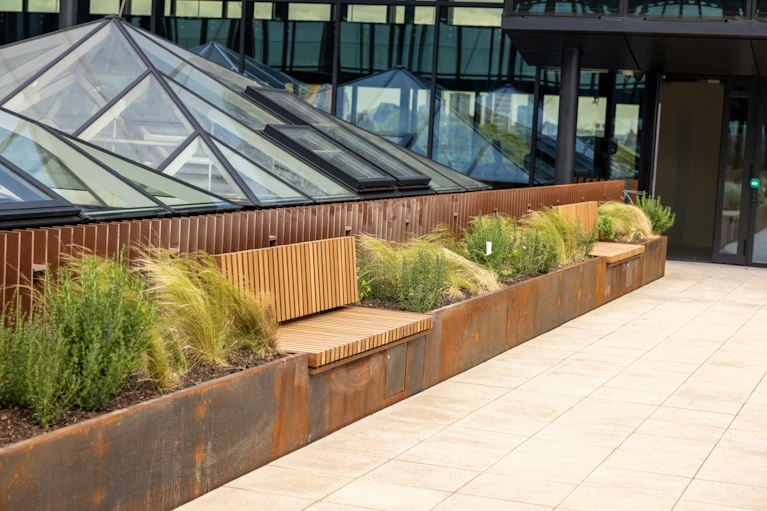
Every part of the deck has to be Class A, not just the boards you walk on. Thatincludes:
  • the frame (joists) the boards sit on
  • the pedestals that hold the frame up off the roof or balcony
  • the clips, spacers and trims holding it together
  • any packers or shims used to level it

‍

READY TO TACKLE YOUR PROJECT NO MATTER SIZE, SHAPE, OR CHALLENGE?

Get in touch with us today!

Thank you! Your submission has been received!
Something went wrong while submitting the form. Please try again.
Kinley Systems orange kinley shape